Winnipeg health care system is
failing us because we don’t have enough hospitals to support the 783, 700
people who live here. We only have six hospitals and probably one 3-4 doctors
on call, depending on the ward. 280,000 people visited the hospital last year
which calculates 23, 333 visits each month and 5833 people a week. Thus equally
out to 972 people in each hospital. The average ambulance wait in 2013 was 78
minutes. According to the WRHA president and CEO Arlene Wilgosh, the WRHA wants
to be able to treat and discharge 90% of emergency rooms patients.
Myrightcare.cu is a website promoting other alternatives to patients to use,
rather than rushing to emergency rooms for less severe incidents or concerns.In my opinion, this won’t really help because
when people are really sick they don’t want to go online.They want to know what is wrong and the place
to go is the hospital where doctors and nurses are to help. Also people will be
a little hesitant to use to website because people don’t trust the internet for
certain research and also people won’t be thinking clear because they are too
busy panicking.
My mom Sylvia Ptashnik, is the
director of residence and services at Deer Lodge Centre,one of the board of directors for the Fred
Douglas committee, and has also been a nurse for 37 years. She worked in
emergency rooms and the intensive care unit for 25 years. I asked her, “Why is
the health care system failing us?” She answered, “When I worked in the emergency
room, ambulance waiting times were a lot faster than they are now and we didn’t
have the amount of people requiring hospital visits as much as we do now.” She
also told me, “about 15-30 years ago people were saying we need more hospitals
to cover the growing population of Winnipeg, but the government denied saying
no we don’t need to build more hospitals. Now they are trying to make up for
their mistakes, but it’s a little too late.”
In my experience with hospital
visits they need to improve the care they give the patients because when I had
my appendix out the nurses didn’t give me good care. For example, when I wanted
clean sheets they told my parents where to find them and my parents changed
them. It is their job to do things like that.
If our money goes into the
health care system, why isn’t it changing or improving. We learned in class
that it is the provincial government’s responsibility to provide us with health
care. In the case study we did on health care on September 18, it states despite
the massive funds put into the system, problems still exist. Waiting room times
for operations, recruitment of new staff – especially doctors and specialists
nursing staff. Arguments continue over where National Health Service funds
would be most appropriately spent. This article is on the health care problems
that are in the United Kingdom but they are similar to the problems that we
have here in Canada.
WRHA flatlineson ER targets By: Larry Kusch Winnipeg Free Press
In a few years, we will have graduated from university or
college and be working in the real world. We will be much more interested in
taxes than we are right now because we will be paying taxes. Some of us will be
paying high taxes, so the sooner we learn about tax systems, the better. There
are a lot of categories of taxes but I’m going to discuss three taxes, each of
which is based on a tax rate.
Progressive tax system
The progressive tax is
based on a person’s income and expenditures. Progressive tax increases as an individual’s
level of income increases. For example, if you earn $10,000 a year, under a
progressive tax, your tax rate could be 10 percent, meaning you would pay
$1,000. If you earn $50,000 a year, a progressive tax rate could be 20 percent,
meaning you would pay $10,000. And if you earn $100,000 then taxed at 30
percent, you would pay $30,000. Many countries including Canada are using the
progressive tax system for the following reasons:
Advantages of progressive taxation:
1.Proper distribution of money: Since
progressive taxation allows income-based taxes, a person with low income will
pay much less than a person with a high income. This is an effective way for
proper distribution of wealth.
2.Protects the lower income group:
Progressive taxation system allows the lower income group to pay less in taxes.
Since most of the working population falls in this category, progressive
taxation is favored by most.
3.Protection during recession times: Progressive
taxation system also protects people during recession times because if their
income drops, they fall into lower income bracket.
Personally, I’m not sure about this system if I earn a
lot of money. However, I think this system is fair because even though people
earn a low income, they still need to buy the basic necessities for their
families. If they paid the same percentage of their income as the rich, the
poverty rate of our country would increase hugely. Many of the rich think this
system is unfair because they are paying a higher percentage of their income
than the poor; thus the tax system is discriminating against them. Other
disadvantages include:
1.Prevents taking high paying jobs:
Progressive taxation system may also prevent individuals from taking a high
paying job because most of their income would be taken away as taxes. It also
discourages individuals to work harder to gain higher incomes.
2.Encourages emigration: High
progressive taxation system can encourage high earning workers to move overseas
to escape the tax system.
3.Encourages hiding of assets: High
progressive taxation system can also encourage high income earners to opt for
off-shore banking by which they can hide their assets and save taxes.
Regressive tax
system
The second tax system that I looked at is the regressive
tax system. It is opposite to the progressive tax system. People earning a high
income pay a lower percentage of tax than people earning a low income. However,
it does not mean that lower income people pay more taxes, they just pay a
higher percentage of their income in taxes. For example, if someone earning $ 40,000
per year pays 10 percent of his income he pays $4000. However, if someone
earning $ 10,000, pays 20 percent of his income, he pays $2000.Therefore, the higher income person is
paying more money but the lower income person is paying a higher proportion of
tax on his lower income.
In my opinion, the regressive tax system is unfair to
poor people. Even though they pay less money than the rich, the government is
taking a larger proportion of their income. That means that the poor have less
income than the rich to pay for basic necessities. That’s why affluent nations
don’t use this as an income tax system.
Proportional
tax
Proportional tax is a tax with a fixed rate like 10%. There
is no change in the tax rate if incomes increase or decrease. It is also called
a flat tax. It does not consider an individual’s circumstances. For example, if
someone is earning $100, they have to pay 10 percent of their income which is
$10 and if someone is earning $10,000, they also pay 10 percent of their income
which is $1000. People like this tax because it treats everyone equally. It is
easy to understand and it’s easy to calculate the amount of taxes owed. In this
system, there would be no exemptions, deductions, or tax credits .Therefore, it
prevents people from cheating and encourages people to earn the highest income
possible which is a benefit for the government and the society.
However, in my personal opinion, I don’t think it is fair
tax system because it takes more of a poor person’s income pay 10 percent than
it does of a rich person’s income. Poor people may feel more burdened by this
tax. They will have less disposable income after paying it than will affluent
people.
My opinion
Before I studied these tax systems I had no knowledge of
how governments levy taxes. Now I know there is no perfect tax system but some
systems are fairer than others. Since all citizens pay taxes, the government
should help them understand the tax systems. Also the government should understand
that inequalities exist in citizens’ ability to pay taxes and consider those inequalities
when levying taxes. In my opinion, the progressive tax system is morally the fairest
system of the three. That doesn’t mean that I will enjoy paying high taxes when
I’m earning lots of money in the future. However, it reflects the best way of
achieving equality and fairness in the tax system.
If you have lots of money, 2012, had one of the best tax
days since the early 1930s: Top tax rates on ordinary income, dividends,
estates, and gifts remain at or near historically low levels. That’s thanks, in
part, to legislation passed in December 2010 by the 111th Congress and signed
by President Barack Obama. Starting January, rates may be headed higher in both
Canada and the U.S but the rich are not worried, they are able to afford their
way out of paying taxes.
For the 400 U.S. taxpayers with the highest adjusted gross
income, the effective federal income tax rate—what they actually pay—fell from
almost 30 percent in 1995 to just over 18 percent in 2008, according to the
Internal Revenue Service. And for the approximately 1.4 million people who make
up the top 1 percent of taxpayers, the effective federal income tax rate
dropped from 29 percent to 23 percent in 2008. It may seem too fantastic to be
true, but the top 400 end up paying a lower rate than the next 1,399,600 or so.
That’s not just good luck. It’s often the result of hard
work.. Much of the income among
the top 400 derives from dividends and capital gains, generated by everything
from appreciated real estate—yes, there is some left—to stocks and the sale of
family businesses.
As Warren Buffet likes to point out, since most of his
income is from dividends, his tax rate is less than that of the people who
clean his office.
Warren Buffet Net Worth: $ 58.5 Billion
What is a
tax haven?
A tax haven is a country that exempts foreign investors who hold bank accounts or set up companies in its territory from taxes.
While citizens and corporations residing in the country are
required to pay their taxes like elsewhere in the world, foreign investors
enjoy, in most cases, total exemption, or at least a substantial reduction of
taxes to be paid. Provided they do not carry on business within the tax haven
itself. States that apply this kind of tax policies do so with the intention of
attracting foreign deposits to strengthen their economy. Most of them are tiny
nations with few natural or industrial resources. Their whole existence would
be threatened were it not for the booming financial industry growing in the
shadow of foreign capital.
Why is this
problem?
Tax havens, also called offshore jurisdictions, have
attracted an increasing number of foreign investors, especially in recent
decades. Usually they are people and businesses fleeing their own country’s tax
collecting voracity in search of a more favorable business environment. This is
not surprising, since in some countries with high taxes, especially in Europe,
the taxes paid by a person or business account for up to 50% of their profit.
This capital flight, of course, is not viewed favorably by
tax officials of the countries that suffer from it, as in the end an important
part of their tax revenue gets away. Therefore, they have tried to react with
different measures to hinder the transfer of assets to tax havens or to make it
unattractive.
But the new world order that emerged with the globalization
of the economy makes it difficult to exert effective control over the movement
of money. Trying to hinder the free flow of capital clashes with the claims of
global trade liberalization, which is defended by, besides most companies and
governments, also by such important institutions as the World Bank, the WTO
(World Trade Organization) and the OECD (Organization for Economic Co-operation
and Development).
On the other hand, the legal measures taken with the
intention of hindering the outflow of capital, and which usually consist of an
unfavorable tax treatment of investments in tax havens, have not yielded the
expected results either.
This is because it is relatively easy to hide the ownership
of offshore corporations or offshore bank accounts; so many people have simply
opted to conduct their operations in secret.
What makes
up a Tax Haven?
·Personal data of owners and shareholders of
companies are not listed in public records, or the use of formal
representatives (called nominees) is allowed.
·There are strict rules on bank secrecy. Data
about account holders are only available to the authorities if there is
evidence of serious crimes such as terrorism or drug trafficking.
·Signing treaties with other countries involving
exchanges of banking or tax information is avoided. Although this situation is
changing in recent years.
·Stability and monetary policy are promoted. Who
would invest in a place with continuous coups d'état, wars or rampant
inflation?
·They have an excellent range of legal,
accounting and tax advice services.
·They often have good tourist and transportation
infrastructure.
What can be
done then against tax havens?
The main actions have been aimed at putting pressure on the
governments of tax havens seeking to limit their confidentiality laws and bank
secrecy. This is currently being done through various international
organizations, usually under the banner of combating terrorism, drug
trafficking and money laundering networks.
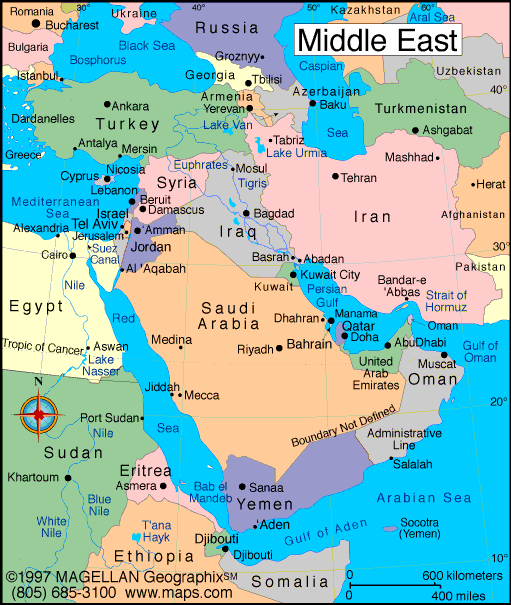
The Political and Economic Shifts in the Middle East
The Indirect Effects of the Various Revolutions Throughout the History of the Region
When we look at the world today, we see an ever changing political spectrum across the globe. Countries that were once the most isolated in the world have now become open to change. In the Middle East, we have seen dictators fall, and revolutions end. However, we often forget about the other nations that are still run by dictatorships, or Monarchies. We know what happens to the nations that are essentially "revolutionized" by the people, but what are the political and economical implications of all this to the other nations who were not part of the arab spring? And what does it mean for the rest of the world today?
Let's begin with the political and economical history of these nations to understand what is happening in our present. The Middle East prior to the age of Colonization was an area of nomadic tribes people who traded with one another. Each group had a regional leader, but it was hard to maintain laws and economic order being nomadic. As time passed people began to settle in the fertile areas amongst the desert. These different tribes slowly grew into Kingdoms. It would take another entire blog post to describe the history of the Middle Eastern settlement patterns. Essentially, the different kingdoms were taken over by different groups throughout history, at certain points all of it would be under control by one group such as the Assyrians, Babylonians, then the Persians. The most recent "imperialistic" empire would be the Ottoman empire, the Persian Empire, and the Sultanate of Egypt. During World War One, these three empires were the major powers in the Middle East. All of which were extremely conservative, socially, and economically. They were not fond of foreign visitors, and international trade was considered taboo. (Unless it was Persian Carpets). The only area that resisted the Empires, was modern day Saudi Arabia.
Following World War One, and World War Two, we saw the Empires fall apart, or shrink in size, due to the uprising of different groups and the support of the international community (The newly formed United Nations). Due to different conflicts and new royal families the political geography of the Middle East changed into what we see today.
In brief Summary, the Ottoman empire split into Turkey, Syria, and Iraq, into totalitarian dictatorships. Persia changed it's name into "The Islamic Peoples Republic of Iran," in which the Emperor, would now be known as the Shah, and had the power to sign, create, or veto bills as he pleased, but there was a lower house which represented the people, and had a Prime Minister. The Sultan of Egypt was over thrown, and the "Republic of Egypt," was created. (Not much of a republic, as the President had power for life.) And the tribal areas, were then United into Saudi Arabia, while certain royal families kept their own kingdoms, such as Jordan, UAE, Kuwait, Oman, Yemen, and Qatar. Of course we cannot forget this was the beginning of the Israeli/Palestinian conflict that has is continuing to this day, as the land was a British Protectorate, and handed over to the Zionists.
It was at this point in time many different, political and economical changes occurred. Post WWII, but Pre-1960's, we saw a fairly liberal Middle East, lenient on its citizens, and allowing domestic trade to occur without government involvement. And since the area wasn't dominated by three major empires, trade began to flourish between the different nations of the Middle East. This did not last for long, In 1954, Texco, BP, and other big oil corporations shifted their viewpoint onto the Middle East, and since these counties were essentially run by governments which need not listen to the wants and concerns of the people, a lot of the nations especially Iran, Syria, Saudi Arabia, and Egypt, began exploiting and selling their oil land to American Companies. This is the beginning of the Modern Arab political and economical map.
As time went on the arabic people started noticing something. "Why was America, and other Western nations, profiting off of their land?" Herein began the conservative revolution of the Arab World. Around the 1960's and 70's, the same time as the height of the cold war, a lot of Arabic nations overthrew the dictators or shah's and installed new governments, which were Pro-Arab Nationalist, or (Anti-Western), in the hope of a new government that would respond to the peoples needs. This created "prosperity" for a minor amount of time, wherein American companies no longer had access to Iranian oil, and in Saudi Arabia, they had to pay new tariffs and taxes in order to access it. This form of economic and foreign policy ideals are very conservative. However the way in which it was dealt with, was rather liberal as the government was in complete control of how much they sold, or kept.
But how long did this new revolution last? Answer is, in relative terms, not very long at all. Basically what happened in most of the countries is that they shifted from an old dictator, with a very liberal attitude towards foreign policy and and conservative economic policies, to a new regime with conservative domestic, and foreign views, and a liberal economic style. So what happened internally, the people began being oppressed, religious minority rights were put on hold, women's rights became non-existent, and money would poor into the upper governmental class, not to the people as they had originally hoped for. These were specifically occurring in countries, like Egypt, Iran, Iraq, Syria, and Tunisia.
This style of economics lasted for about 40 years until the present day, when we saw the Arab Spring occur, and new styles of government have taken over. The Arab Spring began with a mostly bloodless and quick revolution in Tunisia in late 2010 and early 2011. Rebels in Egypt grew significantly more powerful shortly after the revolution in Tunisia. The Egyptian revolution was more violent than the Tunisian Revolution, but it successfully ousted former President Hosni Mubarak after several weeks. The Libyan civil war began immediately on the heels of the Egyptian Revolution, and considerably more violent. Libya is still undergoing its government transformation, but appears to be aiming at a more Islamic government than Gaddafi had led. Additionally, Yemen has also replaced its government after months of violence and protests. Yemen's revolution took place alongside the Egyptian Revolution, but was not nearly so dramatic. The Syrian Revolution is ongoing, and has been about as bloody as the Libyan Revolution. At the moment it appears that the fighting in Syria could go on for a very long time.
The nations that did succeed however, have new interim governments. This is where the topic really gets down to the crux of it all. How do these nations how did rebel, effect the other nations around them that did not rebel. Let's take a look politically, socially, and economically. So out of all the countries that revolted what happened? Egypt, has a new government under the muslim brotherhood, with pro-islamic policies, and arab nationalistic foreign and trade policies. Tunisia's new constitution promotes trade and friendship with other nations, it also allows women to vote, and installed a new democratic government, with term limits. Proving to be one of the most successful revolutions in the region. Syria's conflict is ongoing, and Libya's new interim government recently chose to use Sharia Law as their basis for governmental policy (traditionalist conservative.) So what happened to the other nations that did not revolt? Saudi Arabia, Iran, Turkey (Which recently saw some protests), Jordan, Bahrain (which crushed its revolt), Kuwait, Qatar, UAE, and Oman. First off, the most clear effect, is the fact the un-revolutionized economies, are doing much better than the revolutionized economies. It seems that the policies that these countries had put into practice for so many years, remained effective through tough times. In fact, it can even be possibly assumed that since once family of governmental leaders can make spontaneous political changes, this flexibility helped them weather the economic storm that the arab spring caused.
What does it tell us? It clearly demonstrates that the countries that did not revolt are currently doing better (economically speaking) than the other nations. Why is that? Since the newly created arab nationalist governments refuse to negotiate, trade with, or associate with a lot of the western countries, their economies crash, because the trade is extremely limited. And since their economic style is more left wing, meaning controlled by the government, it's not possibly for individuals or corporations just to pick up a phone and exchange commodities internationally. That's where they differ from the top 10 countries on the above chart. Those nations, while most being ruled by a royal family, have conservative style economies, in which the government plays lesser of a role, and certain rich families own the oil, chemical, and construction industries that dominate the areas economy. That's why when the revolution occurred, they just shifted their markets to the west, which their government actually permitted. That's what's going on economically. But what is going on socially, and politically. How did these nations put down, or receive no threat of rebellion even though they are such "evil" dictators in the eyes of the west. (...Yet even though they're considered evil, the west still trades with them...hypocrisy at its finest.) What we have seen is a gradual shift towards liberalism over domestic issues within these countries. For example; although Qatar is ruled by one royal family, the country has zero taxes, but the health care system is all government run, and completely free, pills for chronic medical conditions are free, nursing homes for the elderly are free, education is all free, welfare is provided in substantial amounts to the small amount of homeless, and women are allowed not to wear the traditional hijab. Or Saudi Arabia, to avoid the revolution they liberalized a lot of their domestic policies, for example women in even the most traditional province (Ha'il) are allowed to have their faces uncovered (a big step, although it may seem minor), they have also began a tourism industry to stimulate the economy of local businesses, and they also have began allowing the practice of other faiths, and sects of islam. Crime and Punishment has also eased, the idea of losing limbs, or your life is extremely rare, even for religious offences which is what the countries laws are based upon. To understand let us watch a few clips of a documentary that the Saudi Government allowed the BBC to create, where they went into the most traditional area of Saudi Arabia and filmed the daily lives of people there. (Clips 1:30, 6:30, 14:40)
As you can see the Saudi Kingdom is much more lenient than the average person understands it to be. As are many of the other nations in the Middle East, besides the ones you hear about in the news.
During the time of the revolution the Saudi Kingdom, Jordan, Dubai, Kuwait, and the other monarchies liberalized a lot of their domestic policies to avoid the revolt they were seeing with their neighbouring nations.
Instead of the news focussing on these good happenings, the media focussed on the revolt in other nations. These policies actually stimulated the economy of the region. This is one of the reasons we are so ignorant towards these matters. It's also interesting to note, that these prospering arab nations also have some of the highest standards of living in the world, and although human rights watch, and other western based organization site these countries as negative, the people within it are often surveyed if they are in favour of democracy, or a more western liberal based democracy, and majority say no. Why? Speed! They complain directly to the government, and laws directly change through these complaints. There is no medium like we have in Western Liberal Democracies. It is also funny enough, that these countries also directly impact the economies of the U.S and other powerful western nations. When the charges of their petroleum goes up, and they prosper guess who has to pay the price? Answer is, all the nations depending on them.
Now that we know of the causes, the revolutions, the effects, and the political shifts, what can we take from all this? In my opinion the countries that have revolutionized and continue to revolutionize are falling into the same trap, they can never fully satisfy the needs or functions of the government to the complete satisfaction of the people. When they revolutionize they put into power radicals, who harm their economy through nationalist policies that sound fantastic to the people at the start but by the end of it, turn out harming the average citizen. The nations who did not or have not been affected by the revolutions as much as the others, who have stuck to their traditions and changed over the course of time are doing much better, than the others as they are slowly changing to suit the needs of their people and the world. These nations with these families in power, I'm sure will one day slowly change into a democracy or some such variation, but that will come with time, and will best suit the needs of the people when they actually want it, or when the economy needs it. We can learn from these nations that there needs to be a balance. Nothing can be extremely liberal, because too much governmental control limits trade and harms the economy, but a too traditionally conservative nation harms the people by letting workers get exploited, and socially dividing people through rights violations. The countries in the middle east who survived the arab spring, economically, and politically speaking are the ones who best balanced themselves, an example that not only the other Arab countries can learn from, but the media in the west should note as well.