Monday, May 19, 2014

Reagenomics

When the phrase "Expansionary Policy," is heard we often hear reference to Reaganomics. What is Reaganomics? Well let's figure that all out. First we need to understand some of the recent history of the American political sphere. During the 1980s, America was still caught up in fear of the Soviet machine. Disappointed with the Carter presidency, America elected Republican Ronald Reagan to the presidency. He promised to combat the "Red Menace" and repair the economy. During the late 1970s America's inflation rate had risen to double digits and the economy was in serious trouble. Reagan stepped in with an ambitious plan that he hoped would revitalize the faltering economy. The plan, dubbed "Reaganomics" by its detractors, was an anti-inflationary and investment promoting system which would stimulate business and give every American more money to go around. The nation eagerly anticipated a successful decade.


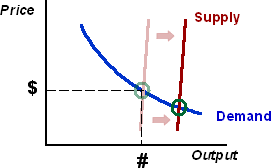
The fundamental idea behind Reaganomics ran opposite to traditional economic thinking. It has been generally agreed upon that an increase in demand will produce an increase in supply to meet the needs of the public. Reagan's administration turned this theory on its head, saying that if a supply were created, demand would follow. If industries were to produce more, the public would discover a need for the product. The plan included tax cuts for big business, allowing them to increase production. By cutting income taxes and giving Americans more money to spend, the plan would promote industry and revitalize the economy. The wealthy of America would benefit the most from income tax cuts and would spend their money, creating new jobs which would, in turn, aid the lower class. Defense spending would also promote industrial growth and create more jobs. This was the famed "trickle down" portion of Reagan's plan.

An important aspect of the Reagan administration was a commitment to fight the spread of the Soviet Union's communist ideals. This would be accomplished by large increases in military spending. Programs like the B-1 bomber, the MX missile, and a complete refit of the Navy were instituted under Reagan. Secretary of Defense Caspar W. Weinberger planned to increase defense spending by 7% annually. Budget Director David Stockman relates that the "none-too-subtle implication was that anyone proposing to even nick his budget wanted to keep us behind the Russians (sic)." Obviously, the need to confront the Soviets was in the forefront of the Reagan administration's plans. The prevalent theory was that the furtherance of capitalism would be useless if it were threatened by communism. The downfall of the Soviet Union at the end of the decade would take everyone by surprise. Whether the true economic situation of the USSR was known to the Reagan administration is hard to say. Intelligence sources reported myriad dangers and security threats, because they tend to err on the side of caution. Indicators of the economic peril of the Soviets were ignored because everyone was so caught up in the perceived threat. One way or the other, the leviathan defense budget went ahead.

The chief problem Reaganomics faced, and the reason it failed to meet its overall goals was that it was internally inconsistent. Reagan's administration professed a desire for a seriously pared down federal government, but never lived up to the promise. This undermined their economic plans. In order to avoid a budget deficit, government spending had to be decreased in conjunction with taxes. The Reagan administration was singularly unable to achieve this. Whatever advances it made in lowering government spending were made up for by increases in other areas. While Education and regional development took major cuts, Medicare and Commerce grew by leaps and bounds. The greatest increase in spending, however, came from defense. Military spending grew by 63.3% from 1981 to 1989. Under Reagan the economy never took in as much as it spent. Reagan was able to achieve some of his ends. He was able to increase the rate of growth of the Gross Domestic Product to 3.9% from its rate of 0.5% under Carter. Family income rose and unemployment decreased. However, during his presidency the trade deficit rose from $15 billion to $129 billion and the budget deficit went from $74 billion to $155 billion. Most staggeringly, the national debt increased from a hefty $730 billion to a  $2.1 trillion. During the 1980s, many of the premier economic thinkers held that deficit spending was not a cause for concern. The government was not expected to behave like a corporation and could get by without paying its debts. However, upon witnessing the effects of a $2.1 trillion debt, most changed their tune. Without decreasing government spending along with taxes, Reagan was unable to achieve all of his economic goals and the nation was plunged into a deficit.

Another flaw within Reaganomics was the reliance on supply side economics. The intent of Reagan's plan was to rebuild America's military to combat inflation and redistribute income to the major corporations. Had America's economic troubles been the result of unused capacity as it was after WWII and Korea, Reagan's plan would have been very successful. The unsatisfied demand would have been fulfilled. Unfortunately, when no such demand existed, the extra production went to waste. Furthermore, in the 1980s American businesses were forced to compete with foreign products. What little demand existed was already taken care of.

Reagan's administration was unable to reconcile their desire to restore the quasi-mythical laissez faire American economy with their desire to out-price the Soviets in the arms race. It is a matter of heated debate whether Reagan meant to drive the Soviet economy into the ground by increasing defense spending. Many hold that the Soviet economy was already well along the way towards its own economic demise and Reagan's aggressive defense spending, the Strategic Defense Initiative, was merely incidental. Intentional or not, the wanton defense spending of the 1980s had lasting economic effects that would leave the economy in dismal shape by the end of the decade and the beginning of the 1990s. Fortunately, the economy has since largely recovered thanks to the efforts of Congress and the Clinton administration in balancing the budget. The government of the 1990s learned an important lesson from the problems faced in the 1980s. Reagan's plan would have been far more successful had he found a single goal and stuck to it. Defense and other forms of government spending stood in the way of his economic plans.

The long-term effect of Reaganomics is a hotly debated issue in history. Many Republicans who once rejected Reagan's ideas now hold them as a party standard, pointing to the incredible growth of the 1990's as proof that Reaganomics were effective. Opponents, however, blame the deregulation espoused by Reagan's supporters as being responsible for the crashes during the term of George W. Bush giving credit to the growth in the 1990's to George H.W. Bush and Bill Clinton.
Whatever your particular political leanings, it cannot be denied that Reaganomics has had a strong effect on the conversation of economics in America. The growth numbers during Reagan's time in office cannot be denied, even if the larger effects beyond his term may never be fully explained. Ronald Reagan remains a powerful figure in the minds of Democrats and Republicans alike. It is likely that his economic policies will continue to affect politics for years to come.


Anthony S. Campagna The Economy in the Reagan Years : The Economic Consequences of the Reagan Administration, Vol. 150 (Greenwood Publishing Group, Inc., 1994)
Murray Weidenbaum Reaganomics - Its Remarkable Results (The Christian Science Monitor, Dec. 18, 1997)
Mike Noble Where Reagan Went Wrong [online] "http://oasis.bellevue.k12.wa.us/sammamish/ sstudies.dir/hist_docs.dir/reaganomics.mn.html" (Mike Noble, 1995)

Sunday, May 11, 2014

WE NEED SUPPLY!

- Last week in Class...
Through May 5-9 the fine economics class of St. Maurice school had been busy preparing for the test we are to receive this week. We had been reviewing various terms, going over case studies, and sadly... cramming for biology tests/quizzes. Yet, Miss Teetaert was devoted to ensuring her class stayed motivated through various outlets of markable material. During two review periods, one for marks and the other for candy, the topic of Supply-side economics came up. The class had agreed that this term was to be defined as "Describes a stabilization policy that stresses increasing the supply of goods and services in order to reduce the level of prices and to create jobs to counter unemployment." This definition is simply not enough, and because I want to ensure everyone gets 100% on the topic of Supply-Side economics tomorrow, lets talk about it.
- Why Consider Supply-side Economics?
Both Monetary and Fiscal policy (policies we have studied) fall on the demand side of economics. They both influence the level of spending in a nation's economy. When there is a general movement to spend less the rate of inflation falls, yet the number of people unemployed rises. This is due to the fact that people are, generally, "saving" their money. In turn, businesses receive less money and cutback on production and labour forces.
On the other had, if spending was to increase the demand for employees would rise and unemployment rates would fall! This sudden rise in spending also has its drawbacks... increased spending raises prices because this thrust in demand for goods/services may overtake levels of supply. To ramp up supply in order to keep up with this sudden demand companies would have to raise prices to produce new levels of goods and services.
To combat this issue, Supply-side economics is introduced. To combat both unemployment and inflation policies would be introduced to increase the supply of goods and services. If supply increases, prices fall (or rise more slowly) therefore reducing the rate of inflation. More workers are needed to produce the additional products and conduct services, so in this way unemployment rates would fall as well.

- What needs to be done? 
Those who believe in Supply-side economics believe that the best policies for this method are carried out by cutting taxes and reducing government regulations that restrict production.  

- Implementing Tax Cuts for businesses and society 
1) This would provide businesses with more money for investment. These funds could be used for improving equipment, repairing equipment, for new construction and researching development models. Tax cuts allow a business to use saved money to produce more and ultimately stay competitive. This ensures supply increases while keeping prices static. Also, to create more product and invest in a company there is a need for additional employees to carry out these tasks. 
2) A tax cut would also provide and incentive for individuals to earn more money and increase spending. With progressive income tax higher-income individuals pay a higher percentage of their income in taxes, this discourages people from earning more money. A tax reduction puts extra revenue in the pockets of the everyday citizens. As we have learned, when people have more money they typically spend it, this facilitates the increase in supply of goods and services. 
- Reducing Government Regulations 
1) Firstly, reducing Government regulations would reduce business costs, this would then lead to a reduction in prices. Due to the fact that current government regulations greatly increase the cost of doing business, companies must counter this by increasing price. But, if regulations are lifted and demand stays the same, prices will fall. Businesses would no longer have to abide by the premium costs of regulations, allowing their prices to adjust to the money saved. This action would hopefully lead to the purchasing of more goods by consumers. 
2) Secondly, through lifting legal restrictions businesses would have the ability to produce more. Many restrictions that companies face is at the manufacturing level. If these regulations were relaxed or eliminated production of products would skyrocket. Employment at manufacturing, shipping and sales positions would rise with the ability of the company to produce on larger scales. This, of course, would lead to lower levels of inflation, because the financial penalties and/or production penalties would be eliminated; allowing businesses to supply products at new heights! 
-The Bad
1) Regulations are extremely hard to change. This is true in terms of regulations that attempt to protect the environment. If there is a relaxation in pollution controls, overtime a company may be able to produce large quantities but at what price? It does not make sense to remove vital environmental protection regulations to ensure mass production of goods and services for the present time.
2) There is no guarantee that once a company enters the stage of increasing production it will employee those within the nation. Using the method of Supply-side economics companies may take advantage of dollars saved and inject it into foreign labour. It would be safe to say that a large production company would likely outsource in order to save money during the process of increasing its inventory. In a time of great savings and freedom, why wouldn't an international business take advantage of a charitable economy and planet? 
- My Opinion 
I believe that the fundamental purpose of Supply-side economics is a great aid to a nation. It is a process that creates jobs, stimulates business nationally, lowers prices of goods and services and establishes a level of stability for both parties. I believe that tax cuts may be a measure that can help facilitate this process. Companies that have a keen sense for production value and creating consumer buzz around their products would take full advantage of these cuts. Additionally, regular citizens are able to save money that would have been taken and use it towards supporting Canadian business. 
Still, I believe the problem lies with what the business plans to do with the money it has saved. I feel that too many businesses would use this saved revenue and inject it into foreign programs where their products could be produced at low rates. I do not agree with softening or eliminating regulations. I feel that they are in place for a reason, and to remove them would have our Government bow down to business over issues we can't afford to lose. Overall, Supply-side economics is a marvellous tool in the fight against unemployment and inflation. But, as a nation, we must ensure that this tool is placed in the right hands, lest it stab us in the back. 


Tuesday, May 6, 2014

Monetary Policy

Monetary policy 

Recently in our economics class we have been looking into how fiscal policy is used and what actions are carried out to make it work. Fiscal policy is based upon government spending and taxation, we now look at its partner Monetary policy. 

Monetary policy is concerned with how much money circulates in the economy and what that money is worth. It is controlled by the monetary authority of a country, which are those who control the money supply. Monetary policy focuses specifically on banks and federal reserves where all of our money comes from. It uses specific tools to reach these economic objectives which is infinitely the goal of price stability.

Using the tools 

Unlike our usual tools of fiscal policy, the use of taxation and government spending to regulate flow of cash in the economy, Monetary policy focuses mainly on interest rates with these operations are carried out by the Bank of Canada. A main goal by these banks is to use an "inflation control" system which is to keep inflation around 2% the mid point between their 1 -3% goal range. How the bank goes about this inflation control system is basically when demand is high it can push the limits of the economies capacity to produce. To counteract, the bank of Canada will increase interest rates to try and cool off the high rising pressure of inflation. Same way would work when there are low-growth periods in the economy the banks will decrease interest rates to stimulate the economy. These rising and dropping of interest rates can be further described in contractionary and expansionary monetary policy. 

Contractionary Monetary Policy 

This monetary policy decreases the money supply in an economy, by decreasing the money supply in an economy you also cause GDP to decrease. the decrease in money supply will lead to a decrease in consumer spending because of less money, less money to spend, a way this policy tries to help inflation rates.

This type of policy usually steps in when inflation rates are very high; when people have lots of money and prices are low. The governments goal is to then decrease this spending by decreasing the flow of money in the economy which can be done by 
1. Increasing interest rates will also increase the rates at which banks lend. When these rates are high, it is hard for people to obtain loans thus causing less spending
2. Banks have a reserve of cash for high demand withdrawals, when this reserve must increase, banks have less money to lend out. Causing less loans to be made.

Expansionary Monetary Policy 

Just how contractionary policy goes to decrease money supply, expansionary does the exact opposite and increases the money supply. A good example of this would be tax cuts, governments rarely use this policy because it can be risky causing high inflation. When there is a low-growth period they usually do this to start the circulation of money in the economy. Thus causing a shift to the right of the aggregate demand curve.

Compare and contrast Fiscal and Monetary Policy 

Now we are going to take a look at how fiscal and monetary policy differ and compare and how they work together to create price stability. 

Comparisons:
Easiest comparison they have is the fact they both are policies designed to counteract high inflation rates. They reduce the severity of recession as the economy needs to get back on its feet. Both have an big effect on demand ex. government increasing taxes and banks increasing interest rates. Side by side fiscal and monetary policies are designed so that recession does not occur. fiscal policies are set so the government can control spending without inflation occurring and monetary policy are set to control the supply of money and continue economic growth. 

Differences 
Besides that fact that fiscal policy involves government spending, and monetary policy is control of money supply there really isn't all that much difference. The only big difference about these policies is the tools they use to go about them. Monetary uses Interest rates,  reserve requirements, and open market operations where as fiscal uses taxation methods, and amount of government spending.


In my opinion 

I believe that monetary policy is an effective and efficient way of going about price stabilization. Using the tools their given, interest rates and the ability to print money I would like to see that they can keep the economy growing and not allowing another recession to occur. Thank you.

g


Sunday, April 27, 2014

Fiscal Policy 101

Here we will look at how the fiscal policy works, how it must be monitored, how its implementation affects different people in an economy, followed by my opinion of it.


What is the Fiscal Policy?
According to Investopedia.com the fiscal policy is the government spending policies that influence macroeconomic conditions. Through fiscal policy, regulators attempt to improve unemployment rates, control inflation, stabilize business cycles and influence interest rates in an effort to control the economy.


How Does the Fiscal Policy Work?
The fiscal policy is based on the theories of British economist John Maynard Keynes (1883–1946). Also known as Keynesian economics, this theory fundamentally states that governments can influence macroeconomic productivity levels by increasing or decreasing tax levels and government spending. This influence curbs inflation (generally considered to be healthy when between 2-3%), increases employment and maintains a healthy value of money. Fiscal policy is very important to the economy. For example, in 2012 many people worried that the fiscal cliff (a simultaneous increase in tax rates and cuts in government spending) was set to occur in January 2013, and would send the U.S. economy back to recession. This problem was avoided by the passing of the American Taxpayer Relief Act on January 1, 2013.


Should the Fiscal Policy be Monitored?
Firstly, you must consider for the objective of fiscal policy, which is to find a balance between changing tax rates and government spending. For example, stimulating a sluggish economy by increasing spending or decreasing taxes runs the risk of causing inflation. This is due to an increase in the amount of money in the economy, followed by an increase in consumer demand, which can result in a decrease in the value of money.


Let's say that an economy has slowed down. Unemployment levels are up, consumer spending is down and businesses are not making steady profits. The government therefore decides to fuel the economy and increase aggregate demand by decreasing taxes, which gives consumers more spending money, while increasing government spending in the form of buying services from the market (such as building roads or schools). By paying for these services, the government then creates jobs and wages that are pumped back into the economy. Meanwhile, overall unemployment levels will decline. The government is now practicing expansionary fiscal policy. Now, with more money in the economy and fewer taxes to pay, consumer demand for goods and services increases. This revives businesses and turns the cycle around from sluggish to active.

However, if there are no brakes on this process, the increase in economic productivity will cross over a fine line and lead to too much money in the market. This surplus decreases the value of money while pushing up prices (because of the increase in demand for consumer products). Hence, inflation will exceed the reasonable level. This is why, fine tuning the economy through fiscal policy alone can be a difficult means to reach economic goals. If not closely monitored, the line between a productive economy and one that is drowning in inflation can easily be lost.

The economy may need a slowdown when inflation is too strong. In this situation, the government can use the contractionary fiscal policy to increase taxes to basically take money out of the economy. Fiscal policy could also order a decrease in government spending and thus decrease the money in circulation. Certainly, the negative effects of such a policy in the long run could be a sluggish economy and high unemployment levels. In hopes of evening out the business cycles, the government may continue to use its fiscal policy to fine-tune spending and tax levels.

Who Does the Fiscal Policy Affect?
Unfortunately, the fiscal policy will not affect everyone in the same manner. Depending on the political goals of the policymakers, a tax cut could affect only the middle class, which is typically the largest economic group. In times of economic downfall and rising taxes, it is this same group that may have to pay more taxes than the upper class.


Correspondingly, when the government decides to adjust its spending, its policy may affect only a specific group of people. A decision to build a new road, for example, will give work and more income to hundreds of construction workers. On the other hand, a decision to spend money on building a new jet benefits only a small, specialized group of experts, which would not do much to increase aggregate employment levels.

What Does it all Boils Down to?
One of the most considerable obstacles facing policymakers is deciding how much the government should be involved in the economy. Undeniably, there have been numerous degrees of government interference over the years. Although, for the most part, it is accepted that a certain degree of government involvement is necessary to sustain a thriving economy, on which the economic well-being of the population is dependent on.

 In My Opinion
I believe that the fiscal policy is effective in democratic countries for the most simplistic reason being that government intervention is an essential component of a growing economy. Say for example a recession would take place, as consumption and investment decline, the government can boost its expenditures to offset them. This is because the government can discretionarily change its level of spending with the main objective being to return the economy to the desirable growth. Overall, despite its few flaws, I believe the fiscal policy works effectively in Canada.


Wednesday, April 23, 2014


Expansionary fiscal policy vs. contractionary fiscal policy
By: Marc Mance
 
Last week, we were not able to discuss much due to our 3 classes in the 4 day week but out of what were given through handouts, I have decided to compare expansionary fiscal policy and contractionary fiscal policy. Expansionary fiscal policy involves government attempts to increase aggregate demand and contractionary fiscal policy describes a reduction in the amount of money used by the government or a growth in the amount of money bought in, usually through taxes.


To compare the two types of fiscal policies; we see that the aggregate demand increases in the expansionary policy. According to Keynesian economics, if the economy is producing less than potential output, the government spending can be used to employ idle resources and boost the output. When there is an increase in government spending, it will lead to an increase in aggregate demand which then leads to an increase in the real GDP, resulting in a rise in prices. On the other hand, the government can adopt a contractionary policy and decrease government spending which decreases the aggregate demand and the real GDP, resulting in a decrease in prices.
Effects of expansionary fiscal policy
·         Investment
o   Investment can be affected by increasing the government expenditures to help boost the economy. This type of fiscal policy is used by the government to influence the level of aggregate demand in the economy through price stability and economic growth which promoted further investment into firms.
·         Interest rates
o   While the contractionary fiscal policy pulls the interest rate down, expansionary fiscal policy pushes them up. When output increases, the price level increases as well. As the price level rises, people demand more money to purchase goods and services. Since there is no change in the money supplied, this increased demand for money leads to an increase in the interest rates.
Effects of contractionary fiscal policy
·         Government purchasing
o   Involves a decrease in government spending to assorted agencies which then reduce their purchases which decease the aggregate production, income and the rate of inflation
·         Taxes
o   Involves an increase of the income tax rates which provides the household sector with less disposable income that can be used for consumption expenditures which then reduces aggregate production and employment and leads to further decreases in income.
Example
An economist named Abigail Noble is assisting the International Monetary Fund (IMF) in developing policy recommendations for different economies. She met with finance ministers of newly formed states of Sacramento and Salamia.
Sacramento has an inflation rate of 7% as compared to the average of 3%, unemployment rate of 2% as compared with natural unemployment rate of 4%, budget deficit of 5% and a GDP growth rate of 6% as compared to the average growth rate of 3%. Salamia has 1% inflation, 8% unemployment as compared to average of 4%, budget surplus of 4% and GDP growth rate of 1.5%.
Due to Salamia’s low inflation, high unemployment, a budget surplus and a low growth rate, statistics clearly show that it is facing recessionary pressures which make expansionary fiscal policy very appropriate for this situation. By decreasing taxes and increasing government spending, it will eliminate the budget surplus, increase growth rate, increase inflation and decrease unemployment. On the other hand, Sacramento has high inflation, low unemployment, a budget deficit and a high growth rate shows that it is facing inflationary pressures which make contractionary fiscal policy appropriate for this situation. Increasing taxes and decreasing its government spending will reduce the budget deficit, decrease growth rate, decrease inflation and increase unemployment.

Monday, April 14, 2014


Labor Trends: College Graduates
Hello everyone. Last week, we didn't discuss that many things because of the test, but one thing that caught my attention in the labor trends unit was college graduates having better jobs. Having a college degree leads to higher earnings and more career opportunities. But is it true? This is what I will be talking about in this blog post.
On average, college graduates earn more money, experience less unemployment, and have a wider variety of career options than other workers do. A college degree also makes it easier to enter many of the fastest growing, highest paying occupations. In some occupations, having a degree is the only way to get the job. As a whole, college educated workers earn more money than workers who have less education. In 2003, workers who had a bachelor's degree had median weekly earnings of $900, compared to high school graduates who earned $554 a week, which is a difference of $346 per week, or a 62% increase in median earnings. For workers who had a master's, doctoral, or professional degree, median earnings were even higher.
The chart below show four different groups of people. The light brown line shows people who have received a high school diploma or less, with their annual earnings at around $25,000-$26,000. The gray line shows people who have completed some college without a degree, with their annual earnings at around $30,000-$32,000. The dark brown line shows people who have completed college with an associate degree, with their annual earnings at around $33,000-$36,000. The black line shows people who have completed college with a bachelor's or graduate degree, with their annual earnings at around $47,000-$60,000.


As you can see, there is a huge different in annual earnings between people who have a bachelor's or graduate degree compared to people with lower degrees or none at all. A college education can be costly of course, in terms of both time and money, but in the end the reward is well worth it.


I have this chart  to show the unemployment rates for college graduates compared to other groups. Young workers are those aged 22 to 27 without a bachelor’s degree or higher have an unemployment rate between 8%-16%. All workers are those aged 16 to 65, have an unemployment rate between 5%-10%. Recent college graduates are those aged 22 to 27 with a bachelor's degree or higher have an unemployment rate between 3%-7%. College graduates are those aged 22 to 65 with a bachelors degree or higher, have an unemployment rate of 3%-4%.
From looking at these two charts, it is clear that completing college with a bachelor's degree or higher not only secures a good paying job, but lowers the chance of unemployment for that person. Now, going back to what I said at the start about if it is true that having a college degree leads to higher earnings and more career opportunities, it is in fact true. In my opinion, it is well worth it to go to college and graduate some sort of degree. College can be very costly and time consuming, but the reward is worth it.

Tuesday, April 8, 2014

Unemployment

Hello classmates, In recent times we have been studying the topic of the labour force and unemployment. This is what I shall be discussing today.....

The labour force consists of those who are at the age of sixteen or older that are currently employed or are looking for work. Even those who are not working but are seeking for work are included in the labour force, which I personally believe to be odd and misleading. If the labour force consisted of those who legally work at a business, paper route or mow lawns. The rates and different types of unemployments could be displayed more accurately. In my opinion those included in the labour force should only be those that are working at the time. Those who are considered out of the labour force are those who do not want a job and those who are discouraged. How can unemployment rates be shown accurately if those who are looking for work are considered in the labour force? it can't , I believe if we knew the real number of people that are not working and are abusing the system. We would not so easily hand over our hard earned cash to the government in taxes.


A Person is considered employed if they are working part or full time hours. A person who is underemployed works part time hours but could or wants to work full time hours. There are many businesses that under employ many of their workers due to no shows, labour costs and also because business owners do not want to have their hands tied behind their backs just incase an employee with many shifts decides he or she does not want to work that week. Underemployment is a very smart business tactic for the owners, but for the workers it is not so enjoyable receiving barely any hours on the schedule.

Canada has an unemployment rate of 7.2% which is not bad, but unemployment among youth has become bigger then it has ever been. This generation is much more educated then the last one, but are struggling to find jobs now more then ever. I personally believe that is due to inexperience in the workplace, high student loan debt and also the amount of people that are seeking to certain professions as a career is becoming crowded.

The labour force survey excludes too many people in my opinion to be accurately showing the general population who is working and who is not, again I believe it is so that the general public keeps quiet and keeps paying their hard earned dollars in taxes to a corrupt government.

The labour force survey excludes residents of the three territories (which are filled with tax payed reserves)
Persons living on indian reserves, inmates and full time members of the armed forces. With the armed forces it is understandable that they could be excluded from the labour force, inmates aswell, but for any other exclusions I believe it is inexcusable and it does not accurately show who is and who is not part of the labour force.

There are a few types of unemployment, which show different reasons as to why people don't have jobs.

There is frictional unemployment which includes those who are searching for jobs or are waiting for a call back from a job. You could say that these types of people are between jobs but are still making an effort to find employment.

There is structural unemployment and this is caused by change in demand for consumer goods in technology. Which could be workers who are no longer needed or are necessary in a procedure to either advancements or demands within a product.

There is Cyclical/demand-deficient which is caused by recession. Which include markets that really go downhill during recession such as the housing market.

Seasonal unemployment is due to changes in the seasons. Nobody needs a landscaping company or a lawn company during the winter months and if you do you probably don't live in Winnipeg.. Natural rate is when the economy is working at its full rate and there is just no room for you, sorry. Please enjoy this video.

https://www.youtube.com/watch?v=If-3zgM3kXc